

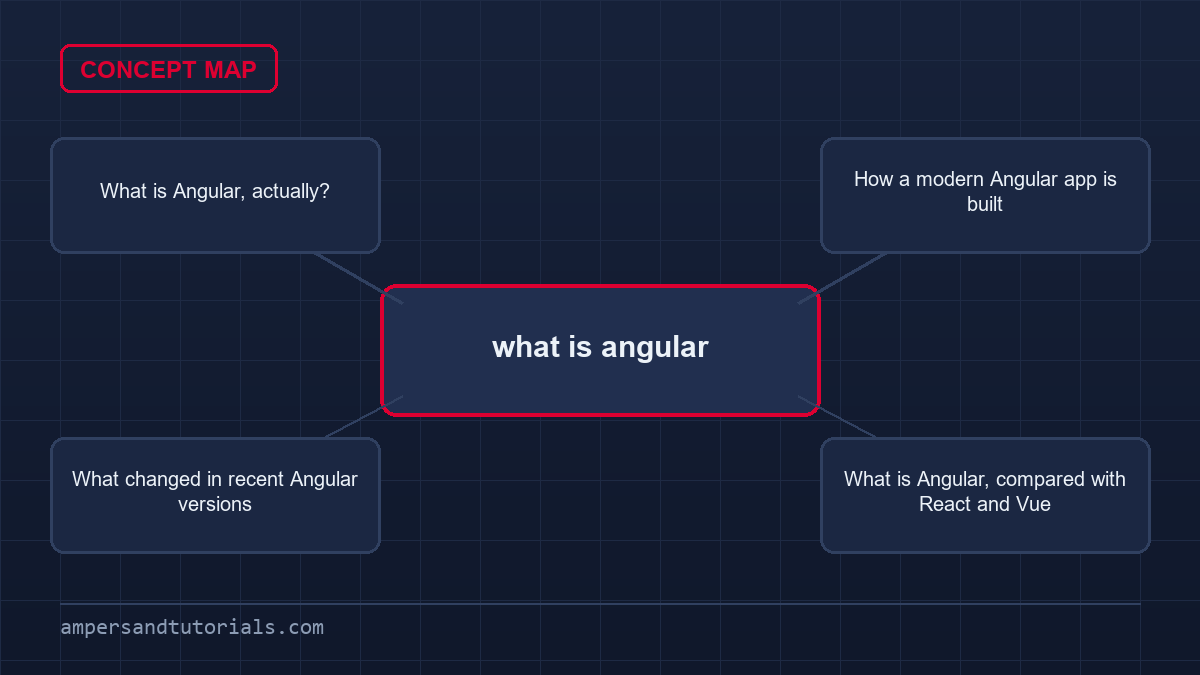
Quick answer: What is Angular? It is a TypeScript-first web framework from Google for building single-page applications. A modern Angular app is a tree of standalone components, wired together with dependency injection, using signals for reactive state and a built-in router, forms system and HTTP client. You install it with the Angular CLI, and the framework handles the rest — no separate libraries to choose.The rest of this guide answers what is Angular in practice: how an app is built, what changed in recent versions, how it compares with React and Vue, and what you need installed before you start. When it is time to build real interfaces, the official Angular Material component library is the natural next step.

Table of Contents

What is Angular, actually?
Angular is a framework, not a library. A library such as React gives you one piece — components — and leaves routing, forms and data fetching to you. Angular ships the whole stack: components, dependency injection, a router, two forms systems, an HTTP client, testing utilities and a command-line tool. Every Angular project is structured the same way, which is why large teams like it.
Angular is written in TypeScript and expects you to write TypeScript too. That decision is the source of both the steeper learning curve and the strong tooling: the compiler catches whole categories of mistakes before the code runs. If you are new to the language, work through our TypeScript learning path first — it pays for itself within the first week of Angular.
How a modern Angular app is built
Three ideas cover most of the framework today: standalone components, signals and built-in control flow. A component is a TypeScript class with a template. A signal is a reactive value that tells Angular when to re-render. Control flow is the @if and @for syntax you write directly in the template.
import { Component, signal } from '@angular/core';

@Component({
  selector: 'app-counter',
  template: `
    <button (click)="increment()">Count: {{ count() }}</button>
    @if (count() > 5) {
      <p>You clicked a lot.</p>
    }
  `,
})
export class CounterComponent {
  count = signal(0);

  increment() {
    this.count.update((c) => c + 1);
  }
}
That single file is a complete component. It owns its state, its markup and its behaviour, and Angular re-renders only the parts that changed because count is a signal. No module file is needed to declare it — this is what “standalone” means, and it has been the default for new projects since Angular 19.
What changed in recent Angular versions
If you last looked at Angular years ago, the framework looks different now. Angular 22 (the current stable line) makes several once-optional features the default:
| Area | Modern Angular (v20+) | Older Angular |
|---|---|---|
| App structure | Standalone components | NgModule declared everything |
| State | Signals | RxJS observables everywhere |
| Control flow | @if, @for, @switch | *ngIf, *ngFor |
| Change detection | Zoneless by default | Zone.js patched the browser |
| Injection | inject() | Constructor parameters |
| Test runner | Vitest | Jasmine and Karma |
The old syntax still works — *ngIf and NgModules are deprecated or legacy, not deleted — so you can read older tutorials and existing codebases. For anything new, use the modern forms above.
What is Angular, compared with React and Vue
React is the most-listed skill in job ads and the gentlest start; Vue sits between the two in both size and structure. Angular is the most opinionated and the most complete. If you are weighing the two biggest options, our Angular vs React comparison walks through the decision with a table and a recommendation.
- Choose Angular for large, long-lived business applications, teams that want one agreed structure, and enterprise environments that value built-in routing, forms and HTTP.
- Choose React for maximum job listings, flexible architecture and a smaller first step.
- Choose Vue for a gentle learning curve with a structure closer to Angular’s.
What you need before you start
Angular assumes four skills. You do not need to master them first, but you need to be comfortable with each:
- HTML — elements, attributes and document structure.
- CSS — enough to style a box and lay out a row of items.
- JavaScript — variables, functions, arrays and objects.
- TypeScript — the type layer Angular is written in.
If you want to skip the guesswork and learn Angular alongside real projects with a mentor, Ampersand Academy teaches the framework one-to-one, from TypeScript through deployment.
Understanding core architecture: what is angular under the hood
Developers exploring what is angular beneath its component abstractions find an integrated platform compiler that transforms TypeScript classes and declarative templates into optimized JavaScript execution instructions. The Angular compiler, known as ngtsc, runs ahead of time during application builds, parsing custom HTML syntax and converting bindings into direct DOM updates without shipping an overhead template parser to browser clients.
Unlike libraries that rely on a runtime virtual DOM to calculate differences through structural reconciliation, compiled Angular instructions interact directly with document object model elements. Every standalone component defines an internal view blueprint containing static HTML markup alongside dynamic data-binding slots. When reactive state updates, the execution engine evaluates the targeted binding slots, skipping unaffected structural elements throughout the component hierarchy.
When architects evaluate what is angular in enterprise codebases, they prioritize this deterministic compilation pipeline because it catches subtle layout errors before code reaches staging environments. Template variables, control directives, and bound event signatures undergo strict type checking against underlying TypeScript models during compilation. Type mismatches break build pipelines immediately, ensuring user interfaces adhere strictly to backend data contracts.
Clarifying what is angular at the template level helps teams avoid runtime errors while standardizing component layouts across distributed engineering groups. By unifying execution semantics inside the core compiler, the runtime guarantees that template expressions remain deterministic and clean. Development organizations can rely on standard static analysis tools to audit application trees before distributing code to production infrastructure.
The framework also enforces strict encapsulation through scoped styles and component shadow boundaries. Each component can isolate its CSS rules using emulated encapsulation, preventing style leaks that plague uncoordinated CSS modifications. This architectural isolation ensures that large teams can modify individual UI modules without unexpected visual regressions across unrelated application views.
Dependency injection patterns in scalable applications
Software teams evaluating what is angular rely heavily on its hierarchical dependency injection engine to decouple business logic from user interface presentation. Unlike libraries requiring manual prop drilling or external state stores, Angular provides a built-in resolution tree spanning the root platform down to individual child component nodes. Services register at specific hierarchy levels, ensuring scoped lifecycles and seamless unit test mocking.
The root injector provisions singleton instances across an entire application using the providedIn property. When specialized features require isolated state or distinct cache instances, component-level injectors instantiate localized service instances that terminate automatically when their host component is destroyed. This hierarchy guarantees strict memory management without requiring manual garbage collection hooks.
This hierarchical resolution reveals what is angular in real production applications: a unified design pattern where data access, telemetry, and business validation remain completely decoupled from view markup. Developers can swap mock implementations during automated testing without modifying component source files, reducing regression risks during major codebase refactoring cycles.
import { Injectable, inject } from '@angular/core';
import { HttpClient } from '@angular/common/http';

@Injectable({ providedIn: 'root' })
export class TelemetryService {
  private http = inject(HttpClient);

  logEvent(eventName: string, payload: Record<string, unknown>) {
    return this.http.post('/api/telemetry', { eventName, payload });
  }
}
import { Injectable, inject } from '@angular/core';
import { HttpClient } from '@angular/common/http';@Injectable({ providedIn: 'root' })
export class TelemetryService {
private http = inject(HttpClient);logEvent(eventName: string, payload: Record<string, unknown>) {
return this.http.post('/api/telemetry', { eventName, payload });
}
}
Modern inject function versus constructor injection
Understanding what is angular without constructor ceremony simplifies testing and modular composition across complex enterprise packages. The modern inject function allows developers to declare dependencies directly inside field initializers, factory functions, and router guards. This approach reduces boilerplate code and prevents inheritance issues when extending foundational base classes across domain boundaries.
Modern inject function versus constructor injection
Functional injection tokens also allow developers to compose reusable behavioral utilities outside class structures. Injection context operates predictably inside execution boundaries such as routing guards and lifecycle initializers. Engineering organizations benefit from cleaner code organization, fewer constructor parameters, and rapid onboarding for developers transitioning from functional programming backgrounds.
Hierarchical injectors also support environment-specific configuration overrides without changing consumer code. By supplying alternate providers at feature boundaries, teams can run offline mock services during local development and seamlessly switch to authenticated cloud endpoints in staging and production builds. This decoupling keeps domain services pure and testable across all deployment targets.
Reactivity pitfalls and signal graph mechanics
Developers asking what is angular doing differently in modern reactivity must examine the fine-grained signal graph introduced to eliminate runtime overhead. Signals establish synchronous reactive primitives that track consumer dependencies automatically upon execution. When a writable signal value changes, dependent computed signals and template consumers update immediately without triggering dirty checking sweeps across unrelated components.
A frequent pitfall involves writing signals inside computation contexts that produce infinite feedback loops. Computed signals must remain strictly pure derivations without side effects, while effect routines should handle DOM logging, external device synchronization, or canvas rendering. Violating this separation leads to runtime circular dependency warnings and degrades client responsiveness under intensive update loads.
Mastering this dependency tracking explains what is angular reactive performance in data-heavy screens such as trading portals and monitoring suites. Because signals notify only explicit subscribers, large views with thousands of dynamic metrics update isolated DOM text nodes directly. Change detection cycles bypass unchanged ancestor components completely, unlocking desktop-class frame rates inside standard web browsers.
Avoiding circular computations illustrates what is angular best practice when managing asynchronous telemetry pipelines across interconnected dashboards. When developers construct reactive state models, establishing clear one-way data boundaries keeps state transitions predictable. Isolating mutations inside explicit event handlers prevents cascading change storms that degrade application responsiveness.
Preventing dependency cycles with untracked reads
Isolating side effects demonstrates what is angular state containment in complex enterprise dashboards where multiple metrics share common time horizons. When an effect must read a secondary signal without registering that signal as an active dependency, wrapping the operation inside an untracked block ensures clean graph execution. This mechanism prevents unintentional triggers when secondary values update independently.
import { Component, signal, computed, effect, untracked } from '@angular/core';

@Component({
  selector: 'app-metric-display',
  template: `<p>Active: {{ activeTotal() }}</p>`,
})
export class MetricDisplayComponent {
  primaryCount = signal(10);
  auditThreshold = signal(100);

  activeTotal = computed(() => this.primaryCount() * 2);

  constructor() {
    effect(() => {
      const total = this.activeTotal();
      const limit = untracked(() => this.auditThreshold());
      if (total > limit) {
        console.warn('Audit threshold reached:', total);
      }
    });
  }
}
import { Component, signal, computed, effect, untracked } from '@angular/core';@Component({
selector: 'app-metric-display',
template: `<p>Active: {{ activeTotal() }}</p>`,
})
export class MetricDisplayComponent {
primaryCount = signal(10);
auditThreshold = signal(100);activeTotal = computed(() => this.primaryCount() * 2);constructor() {
effect(() => {
const total = this.activeTotal();
const limit = untracked(() => this.auditThreshold());
if (total > limit) {
console.warn('Audit threshold reached:', total);
}
});
}
}
Signal interoperability bridges existing asynchronous RxJS streams with modern synchronous state graphs. Functions like toSignal and toObservable allow teams to convert event pipelines into signals seamlessly. This interoperability ensures legacy reactive services function smoothly alongside modern components without forcing complete codebase rewrites.
Enterprise form architecture and dynamic validation pipelines
A thorough investigation into what is angular must analyze its typed reactive forms subsystem designed for mission-critical data collection. Modern web software demands deterministic data collection pipelines that handle strict typing, asynchronous validation with backend services, and dynamic field composition. Angular addresses this need with strongly typed FormGroup, FormControl, and FormArray primitives that mirror server schemas.
Typed forms prevent runtime exceptions by verifying field names and payload types during development. When a backend API schema updates, TypeScript immediately flags mismatched property names inside form definition files. This synchronization minimizes production regressions during high-velocity deployments across distributed engineering teams.
Building dynamic validation pipelines shows what is angular capable of when handling intricate business workflows like mortgage processing or enterprise resource management. Forms support custom validators that execute synchronously for syntax validation, alongside asynchronous validators that verify record uniqueness against remote databases through debounced network streams.
Form safety clarifies what is angular providing to prevent user data loss during submission cycles and navigation events. Form status streams expose pristine, dirty, touched, and pending flags that govern interface validation messages and button states. Developers can bind these signals directly to templates to present clear, accessible error hints without clunky conditional boilerplate.
Managing complex nested arrays provides consistent form architecture across dynamic wizard flows and variable item registries. FormArray controls allow dynamic addition or removal of nested form groups while maintaining top-level validation validity. This structural stability guarantees that enterprise systems submit clean payloads conforming strictly to remote REST and GraphQL definitions.
Cross-field validation rules execute cleanly by evaluating multiple control values simultaneously within a parent group validator. For instance, validating that a departure date precedes a return date occurs at the group level, preventing scattered validation logic across individual input components. This centralized validation model keeps business rules maintainable and easily testable.
Practical implementation workflows: what is angular doing during HTTP requests
Tracing a network request clarifies what is angular end-to-end communication architecture when communicating with secure microservices. The integrated HttpClient module delivers typed responses, automated parameter serialization, and progress events. Instead of bundling disjointed third-party fetch wrappers, applications benefit from a standardized communication backbone built into the framework platform.
Functional HTTP interceptors form an extensible processing pipeline that wraps outgoing requests and incoming responses. Middleware handles authentication token injection, automated retries with exponential backoff algorithms, centralized error capturing, and offline caching strategies. By configuring interceptors centrally, development teams keep individual service classes clean and focused strictly on business domains.
This interceptor chain defines what is angular resilience when handling authentication tokens and global telemetry across thousands of user interactions. If a token expires during an active session, an interceptor catches the unauthorized error, pauses dependent outgoing calls, requests a refreshed credential, and replays the original requests transparently without disrupting active user workflows.
Connecting HTTP streaming into signals explains what is angular modern data-loading pattern when building real-time monitoring portals. Through integrated signal utilities, incoming asynchronous streams map directly into signal state, giving templates reactive access to remote data payloads with clear loading, success, and error branches.
import { HttpInterceptorFn, HttpRequest, HttpHandlerFn } from '@angular/common/http';
import { inject } from '@angular/core';
import { AuthService } from './auth.service';

export const authInterceptor: HttpInterceptorFn = (req: HttpRequest<unknown>, next: HttpHandlerFn) => {
  const authService = inject(AuthService);
  const token = authService.getAccessToken();

  if (!token) {
    return next(req);
  }

  const authenticatedRequest = req.clone({
    headers: req.headers.set('Authorization', `Bearer ${token}`),
  });

  return next(authenticatedRequest);
};
import { HttpInterceptorFn, HttpRequest, HttpHandlerFn } from '@angular/common/http';
import { inject } from '@angular/core';
import { AuthService } from './auth.service';export const authInterceptor: HttpInterceptorFn = (req: HttpRequest<unknown>, next: HttpHandlerFn) => {
const authService = inject(AuthService);
const token = authService.getAccessToken();if (!token) {
return next(req);
}const authenticatedRequest = req.clone({
headers: req.headers.set('Authorization', `Bearer ${token}`),
});return next(authenticatedRequest);
};
Canceling obsolete network requests occurs automatically when components unbind or route parameters shift. Because HTTP operations integrate with standard reactive lifecycle hooks, navigating away from a slow search view aborts the pending network call immediately. This prevents race conditions and conserves mobile bandwidth on constrained networks.
Server-side rendering, hydration, and production deployment
Evaluating what is angular for server-side rendering requires understanding full hydration and event replay mechanisms designed to deliver instant page loads. Historical server-side architectures suffered from noticeable screen flicker because client runtimes destroyed server-rendered HTML before rebuilding DOM elements from scratch. Modern versions use non-destructive hydration to preserve server HTML and wire up reactivity seamlessly.
During hydration, client scripts traverse the existing DOM hierarchy, matching server-rendered nodes to corresponding component structures without re-executing layout passes. Static assets and pre-rendered content become interactive immediately, improving Largest Contentful Paint and Cumulative Layout Shift scores on mobile devices operating under weak cellular connections.
Eliminating hydration flicker demonstrates what is angular maturity in mission-critical customer portals where perceptual performance directly impacts conversion rates. Modern builds support incremental hydration boundaries where complex lower-page widgets defer script loading until user scroll actions bring those components into the visible viewport.
Hydration boundaries and event replay mechanics
Deploying optimized server bundles solidifies what is angular delivering to production web environments requiring high availability and rigorous accessibility. Event replay captures early user interactions that take place while JavaScript bundles download in the background. As soon as the client hydration pass completes, queued interactions trigger their expected handlers accurately, ensuring no user clicks disappear.
Production deployment pipelines benefit from native integration with modern edge platforms and container clusters. Production builds leverage modern bundling utilities to output lean, differential bundles with ahead-of-time tree shaking. Automated asset compression, cache hash naming, and content security policy generation work together out of the box, ensuring that deployed enterprise architectures remain secure, performant, and resilient under sustained production traffic.
Monitoring production health relies on standardized error handling hooks that capture unhandled exceptions across zones or zoneless schedulers. ErrorHandler providers send stack traces, route metadata, and active component contexts directly to centralized observability platforms. This instrumentation guarantees that engineering teams detect and remediate client errors before users report degradation.
Frequently asked questions
Is Angular a framework or a library?
Angular is a framework. It includes routing, forms, an HTTP client, dependency injection and a CLI in one opinionated package, while libraries such as React provide components and leave the rest to you.
Do I need to learn TypeScript before Angular?
You should be comfortable with TypeScript basics first. Angular is written in TypeScript and its tooling depends on types, so learning the two together makes both harder.
Is Angular still worth learning in 2026?
Yes. Angular has a stable six-month release cadence, deep enterprise adoption and a modern rewrite around signals and standalone components. It remains a strong choice for large business applications.
What is a standalone component in Angular?
A standalone component declares its own imports instead of being declared in an NgModule. It is the default for new Angular projects and keeps each feature self-contained.
Is Angular harder than React?
Angular has a steeper start because you learn the framework, TypeScript and dependency injection sooner. React starts smaller but asks you to choose supporting libraries as you go.
Last updated on · Written by Dinesh Kumar R