



Quick answer: Nucleic acids are polymers of nucleotides that store and transmit genetic information. DNA stores it as a stable double helix, while RNA usually works as a single strand that reads, regulates, and helps build protein. Both rely on sugar, phosphate, and nitrogenous bases, joined by phosphodiester bonds that build the sugar phosphate backbone.
Know about nucleic acids their composition in detail
Of all the polymeric compounds found in living cells, and as vital components of living material, none are so important as the nucleic acids. Swiss physician Fredrich Miescher isolated a substance from pus cells and called it ‘Nucelin’. It was neither a protein, a lipid nor a carbohydrate. Being a novel type of biomolecule isolated from the nuclei of white blood cells with acidic properties, it was called Nucleic acid.
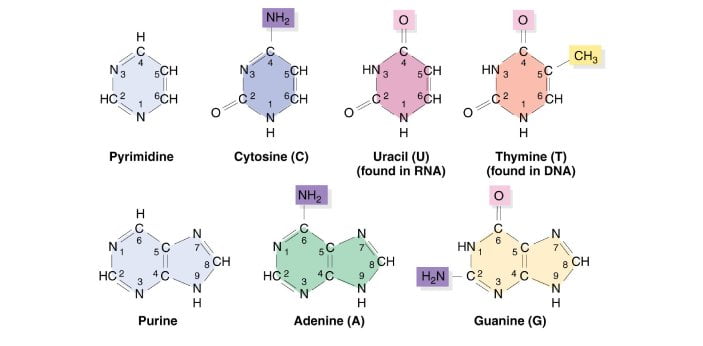
He also determined that the nuclein was made up of hydrogen, oxygen, nitrogen and phosphorous, and there was a unique ratio of nitrogen to phosphorus (N/P- 1.67). Later in the 1920s biochemist, Phoebus from Heidelberg analysed the DNA molecule that contained four nitrogenous bases cytosine, thymine, adenine and guanine; a deoxyribose sugar and a phosphate group and defined nucleotide as a phosphate-sugar base. He also figured the difference between ribose and deoxyribose sugar.
These are two general types, deoxyribonucleic acid (DNA) and ribonucleic acid (RNA). These two can be differentiated by cellular location, molecular size, pyrimidine components and component sugars.

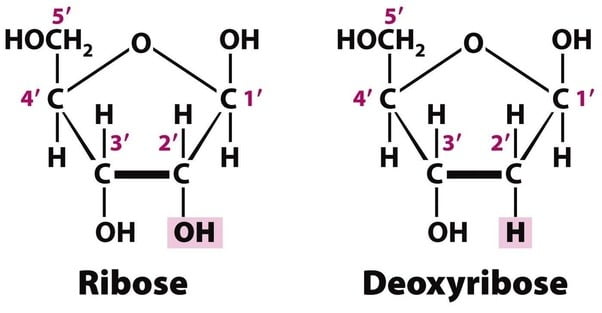
Nucleic acids are biopolymers of high molecular weights. Nucleic acids have nucleotides held together by a 3-5 phosphodiester linkage. Proteins have amino acids as monomers. Nucleic acids have mononucleotides as the repeating units. They gave 15% N2 and 10% P. Nucleic acids are always associated with proteins. These are called nucleoproteins. Complete hydrolysis of nucleic acids gives phosphoric acid, bases and pentose.

Classification of Nucleic acids
Nucleoproteins made of simple proteins and nucleic acids.


Comparison of RNA and DNA
| RNA | DNA | ||
| 1 | On Hydrolysis | Phosphoric acid, D- Ribose, Adenine, Guanine, Cytosine, Uracil | Phosphoric acid, D-2 deoxyribose, Adenine, Guanine, Cytosine, Thymine |
| 2 | Location | Cytoplasm | The chromatin of the nucleus |
| 3 | Weak alkali at pH 9 | Alkali labile forms cyclic monophosphate nucleotide | Alkali stable |
| 4 | Nature | Single-stranded, need not exhibit base complementarity | Double-stranded. Exhibited complementarity |
| 5 | Shape | Strand is folded at some places | Spirally twisted to produce a regular helix |
| 6 | Function | Involved in protein synthesis | Acts as genetic material |
| 7 | Types | Different forms are r RNA, t RNA, m RNA | Intra nuclear and Extracellular |
| 8 | Life span | Short life span | Long-lived |
If you want to learn Bioinformatics as coursework with a certificate. Check our Bioinformatics course from Ampersand Academy. Also read about Next Generation Sequencing.
Frequently asked questions
What are the two main types of nucleic acids?
u003cpu003eDNA and RNA. Both are made of nucleotides, but DNA stores long term information and RNA helps use it.u003c/pu003e
Why is DNA usually double stranded?
u003cpu003eBase pairing gives it a stable, repairable structure. One strand stays intact, so the other can copy genetic information.u003c/pu003e
What is a phosphodiester bond?
u003cpu003eIt is the strong linkage joining one nucleotide sugar to the phosphate of the next, forming the sugar phosphate backbone.u003c/pu003e