


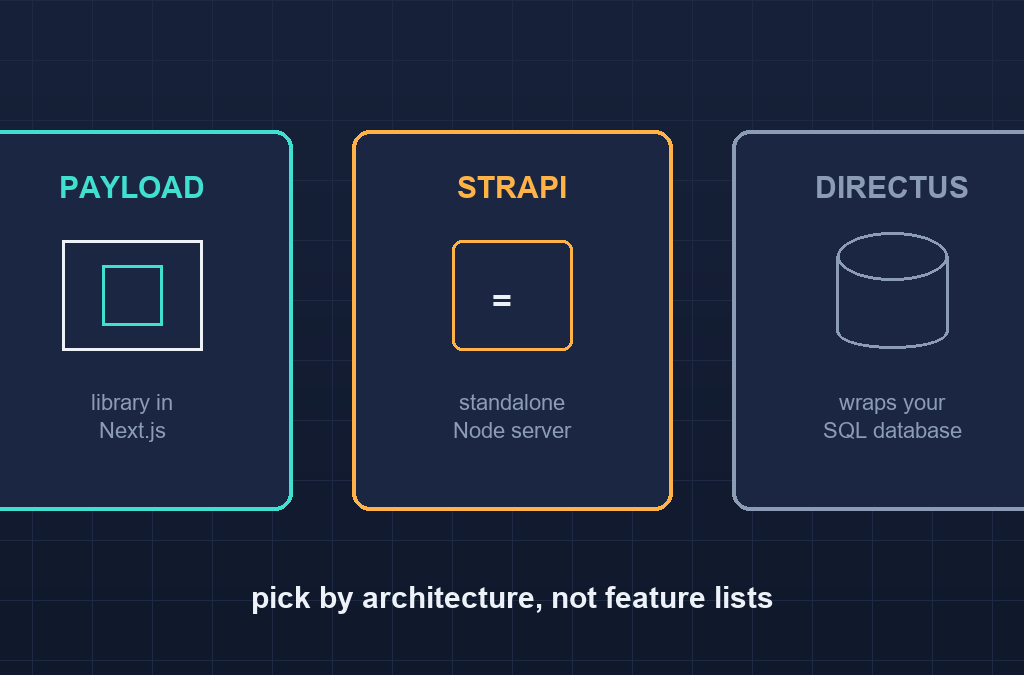
Quick answer: In the Payload CMS vs Strapi vs Directus comparison, all three are open-source headless CMSs, but they sit differently in your stack. Strapi is a separate Node application you deploy and talk to over REST or GraphQL — the most familiar shape, the largest plugin ecosystem, and the most moving parts. Directus sits on top of an existing SQL database and wraps it with APIs and an admin app, which makes it the best fit when the database already exists and must stay authoritative. Payload is a TypeScript library that installs inside your Next.js app, generates its admin panel and types from payload.config.ts, and talks to the database through the Local API with no HTTP round-trip on your own server.
Table of Contents
Part 7 of our Payload CMS series. If the framework is new to you, start with what Payload CMS is and install Payload and build your first collection — both show the code-first model Strapi and Directus do not use.

1. Payload CMS vs Strapi vs Directus: the architectural difference
Before comparing features, pin down where each CMS lives, because that decision shapes your hosting, your types, and your developer workflow.
| Payload | Strapi | Directus | |
|---|---|---|---|
| Install shape | Library inside your Next.js app | Standalone Node server | Standalone Node server over an existing DB |
| Schema source | payload.config.ts in code | Admin UI + code under src/ | Introspects your SQL database |
| Frontend call | Local API getPayload in server components; REST/GraphQL too | REST (/api) and GraphQL | REST, GraphQL, plus raw SQL stays valid |
| Types | Generated from config | Generated, lower fidelity | Introspected from the database |
| Admin panel | Generated from your config | Built-in UI | Built-in UI |
That table is the real decision. If your product is a Next.js app and content is part of it, Payload removes an entire deployment unit. If you want content managed by editors who never touch code, any of the three works, but Payload still keeps the schema in pull requests while the other two put field creation in the admin UI.
2. When Payload is the obvious choice
- The frontend is Next.js (or React) and the content is core to it. A React Server Component calls
payload.find(...)directly, so there is no second origin to host, no CORS, no API tokens, and no network hop between your server and your CMS. - You want the data model in version control. Collections, globals, access rules and hooks review like code. Migrations live beside the config.
- TypeScript matters. Generated types from
payload.config.tsmean renaming a field breaks the build, not a page at runtime. - Auth is app-shaped, not just CMS-shaped. Payload’s auth is a per-collection login system you can use for your own users, not only for editors.
The tradeoff you accept: a Payload project is a codebase. Editors do not create collections in the admin panel, and a “quick content-model change” is a config change with a migration.
3. When Strapi is the better fit
- The CMS must be operable by an editorial team that never opens an editor. Strapi’s content-type builder is UI-first, so modeling happens in the browser.
- You want a large plugin marketplace. Payments integrations, editorial workflow plugins, and community starters are areas where Strapi’s ecosystem is wider.
- The frontend is not Next.js-specific. Strapi serves JSON to a mobile app, a PHP site, or anything else over well-established REST/GraphQL patterns.
The costs that stand out: Strapi is a second server to deploy, secure, and keep warm; the database it manages is its own, so hooking existing SQL in is not the design; and TS types flow from the API layer rather than config you own. Scaling is a familiar Node scaling problem — which is a plus if you already run Node services, and overhead if you do not.
4. When Directus is the better fit
- The SQL database already exists and must stay authoritative. This is Directus’s strongest case: it introspects tables, columns, and relations you already have, then layers an API and admin panel over them without owning the schema.
- You want both API and database access. Existing SQL tooling, BI queries, and raw SQL keep working because the database is untouched.
- Data-model operations happen in SQL, not YAML. Adding a column is a migration in your database, not a config file change.
The costs that stand out: you inherit your schema’s mess into the admin panel; Payload-style code-first abstractions (hooks, access functions in config) look weaker than a plugin model where they live as app code; and the “database is the truth” position also means the CMS can accidentally be bypassed by other writers of the same database.
5. Queries and the Local API
This is where the architectures feel different in daily work.
// Payload — server component, no HTTP
import { getPayload } from 'payload'
import config from '@payload-config'

export async function RelatedPosts() {
  const payload = await getPayload({ config })
  const { docs } = await payload.find({
    collection: 'posts',
    where: { status: { equals: 'published' } },
    limit: 3,
  })
  return <List items={docs} />
}
// Strapi — client or server HTTP call
const res = await fetch(`${process.env.STRAPI_URL}/api/posts?` +
new URLSearchParams({ 'filters[status][$eq]': 'published', 'pagination[pageSize]': '3' }))
const { data } = await res.json()// Directus — same shape as Strapi but against your own database namespace
const res = await fetch(`${process.env.DIRECTUS_URL}/items/posts?` +
new URLSearchParams({ 'filter[status][_eq]': 'published', 'limit': '3' }))
const { data } = await res.json()The Payload version has no URL to leak, no token to rotate for server-to-server calls, and comes back typed. If those properties matter to you, they matter every single call.
6. Access control compared
| Payload | Strapi | Directus | |
|---|---|---|---|
| Model | Functions returning true, false, or a where query per operation | Role + permission rules configured in UI | Role + field + item permissions in UI, with a policy DSL |
| Draft safety | Query constraint (status equals published) at the DB level | Field + role rules | Permissions engine, plus direct DB still open |
| Complexity ceiling | Arbitrary TypeScript | Higher than Payload at the UI level, less flexible in config | High, all via UI + policies |
The honest summary: Payload’s model is the hardest to learn but the most flexible; the other two are faster to get right at the UI level. If you need a query-shaped constraint (“read allowed only when status is published”), Payload expresses it directly, and that pattern protects drafts at the database level regardless of which client does the fetching.
7. Hosting and operational cost
Payload rides along with Next.js hosting: Vercel, Node, Docker, or a VPS all work, and the operational surface is what you already run for the site. Strapi and Directus each add one deployment unit — its own process, health checks, scaling, upgrades, and a database managed by config rather than by traffic. That is not a disqualifier; it is an honest line item. The deployment article walks the Payload production checklist in detail.
Managed offerings exist for all three, but each is young. Expect to bring your own database regardless of your choice.
8. Summary: pick by shape, not by feature list
| Your situation | Best fit |
|---|---|
| Next.js app, TypeScript team, code-first culture | Payload |
| Editorial-team-managed CMS, plugin ecosystem, any frontend | Strapi |
| Existing SQL database that must stay authoritative | Directus |
| One-person project with a Next.js frontend and real content | Payload |
| Non-Next.js frontend, mobile app + site from one CMS | Strapi or Directus |
| Schema owned by a DBA team, not app devs | Directus |
The worst mistake is comparing feature checklists on a landing page. Two of these three choices will cost a rewrite if you get the shape wrong — a code-first CMS bolted under a UI-first team, or a database-first CMS bought by a team that wanted app code over an existing schema. Decide by architecture first.
9. The mistakes you will actually make
- Choosing by feature spreadsheet. Every one of these can do blog, media, and custom fields. The difference is deployment shape, schema authority, and typing — none of which are feature-table rows.
- Treating Local API vs REST as a style preference. It is an infrastructure difference with real latency, auth, and typing consequences.
- Assuming Directus leaves the database clean. It does, but any other writer to the same database can surprise your API — coordinate writers deliberately.
- Assuming Payload’s admin panel is editor-cosmetic. Editors get a full UI, but cannot edit the data model. If they need to, you chose wrong.
- Planning migrations “when we get there.” Payload and Directus both need a production migration story from day one; Strapi leaks schema sync too.
10. Key takeaways and challenge
- All three are open-source and self-hostable; the real difference is where each lives and who owns the schema.
- Payload: library-in-Next.js, code-first, Local API, generated TS types. Strapi: standalone server, UI-first modeling, big plugin ecosystem. Directus: API+admin over an existing SQL database.
- For a Next.js + TypeScript team, Payload removes a deployment unit and an HTTP hop between app and CMS.
- For editorial-team-controlled modeling without touching code, Strapi wins on tooling maturity.
- Directus wins when the database already exists and must remain authoritative.
- Decide by shape first, features second; two of the three choices cost a rewrite if the shape is wrong.
Challenge: write down your current or next project’s answers to four questions — is the frontend Next.js, is the data model expected to change weekly, who edits content, and does the SQL schema already exist? Score each CMS against your four answers before you read another comparison table. Then read the first article again with those answers in mind and see whether the code-first model is actually what your team wants to live with.
Want a real opinion on your stack before you commit a month to a rebuild? Ampersand Academy runs one-to-one mentoring on TypeScript and Next.js backends, including CMS selection reviews. Built and run by Mahadhi — development and digital marketing.
Is Payload easier to use than Strapi?
For a TypeScript team building in Next.js, yes: one codebase, no second server, generated types. For an editorial team that models content in the UI all day, Strapi is more familiar. Easier depends on who is doing the using.
Does Payload cost money?
The self-hosted core is MIT-licensed and free. Strapi and Directus also have free self-hosted tiers, so licensing is not the deciding factor; deployment shape is.
Can I use Payload without Next.js?
Yes. Payload can run behind a custom Node or Express server, but the best-documented and best-typed path is inside a Next.js app, and that is where most examples live.
Is Directus read-only over my SQL database?
No. Directus writes through its API, and other writers to the same database are outside its awareness. Coordinate writers or make Directus the only API-side writer.
Which CMS has the best admin panel?
All three ship a modern admin. Because editors spend all day there, demo each panel with your real content and workflows before deciding; the difference is ergonomic rather than architectural.
Can I migrate from Strapi to Payload later?
Yes, but it is a data migration plus a schema rewrite, not a script run. Budget it as a project and plan the URL redirects alongside the content move.
Which CMS is best for a small solo project?
For a Next.js project with real content, Payload: one repo, one deploy, one source of types. For a non-Next stack or a database that must stay authoritative, Strapi or Directus respectively.